Funding
USDA-NIFA (2023-2026) $750k
Minnesota Terrestrial Plants and Pests Center/LCCMR (2023-2026) $600k
Minnesota Terrestrial Plants and Pests Center/LCCMR (2019-2022) $450k
Minnesota Terrestrial Plants and Pests Center/LCCMR (2016-2018) $200k
Remote sensing invasion using satellite imagery
Unbiased assessment of the distribution and abundance of individual species is fundamental to basic and applied problems in ecology, biogeography, and conservation. However, occurrence datasets are typically spatially biased, which has compromised our ability to fairly test biogeographic predictions (e.g. abundant center hypothesis) and to accurately forecast species’ range shifts. Recent developments in remote sensing have provided avenues for identifying individual species from satellite images with considerable accuracy. Although rarely attempted, remote sensing models increasingly have the potential to characterize the unbiased distribution and population dynamics of individual species over large geographic areas and long time periods.
Our work has focused on leafy spurge (Euphorbia virgata), which is an herbaceous 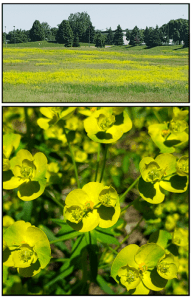 perennial plant that was introduced to North America from Eurasia in the 1800s. It has spread rapidly since introduction, approximately doubling its invaded range every decade through the early 2000s. It now occupies nearly two million hectares of grasslands, rangelands, and open forest edges in the northern United States and southern Canada and is among the most economically damaging invasive plants in the US with losses between 1960-2020 totaling over $1 billion. When damaged, plants produce a latex that can be toxic to livestock, which in turn affects the value of invaded rangelands.
In our first phase of work, we developed deep learning models that identified leafy spurge (Euphorbia virgata) using high and moderate resolution satellite imagery (Worldview-2 and Planetscope) in the Twin Cities, MN region. Our models used spectral and phenological information and identified leafy spurge with > 96% accuracy. In particular, lower resolution Planetscope imagery was as valuable in species identification as higher resolution Worldview imagery with the inclusion of phenology: emergence, flowering, and senescence. (Lake et al. 2022 Remote Sensing in Ecology and Conservation). This work was highlighted in some news outlets: AAAS, Phs.org, Biotechniques, etc.
In the second phase of work, we expanded the spatial and temporal scale of remote sensing using a 21-year Landsat dataset. Here, the objective was to quantify changes in the spatial distribution and population dynamics of leafy spurge across the state of Minnesota. We showed that leafy spurge has expanded from 1,067 km² in 2000–2002 to 7,156 km² in 2018-2020, a 570% increase. Drought severity modulated the predicted area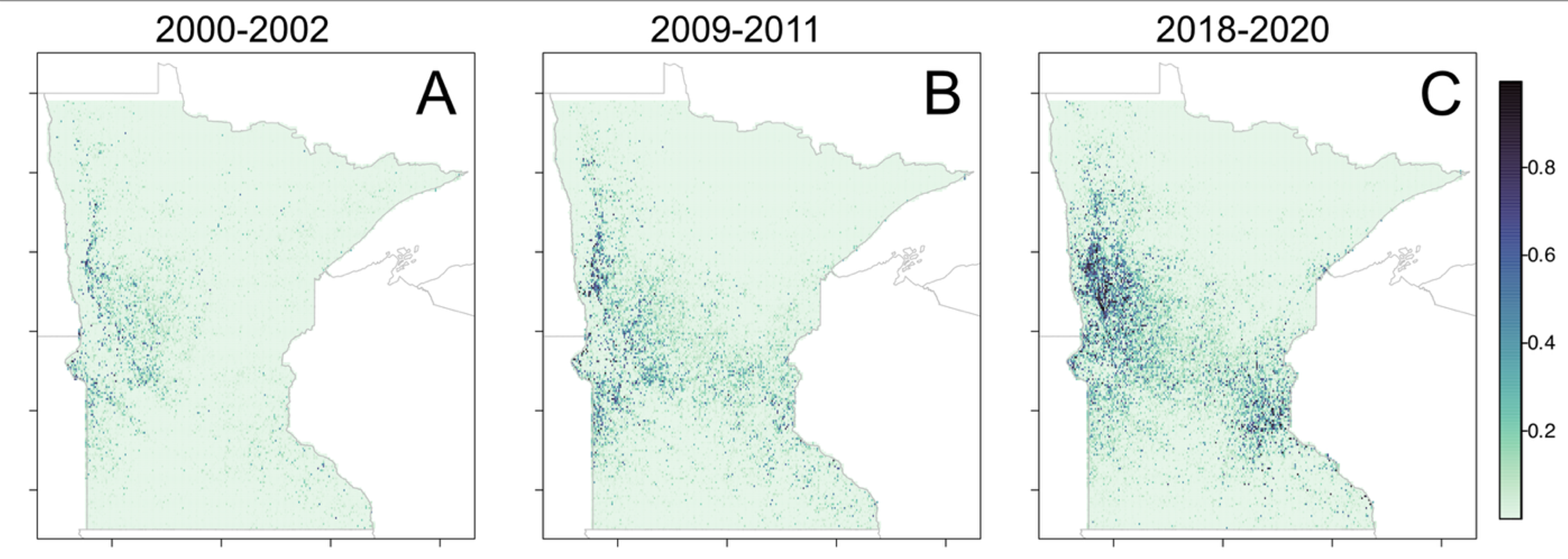
invaded and was associated with fluctuations over time. Second, we tracked changes in probability over time for individual pixels and showed that invasion has been concentrated in two largely disjunct regions that differ in climate. Third, our remotely-sensed occurrence dataset and community science dataset were biased to roadsides, suggesting that roadside disturbance facilitates invasion. Last, we showed that SDMs built using remotely-sensed occurrences had higher discrimination, were less overfit, and performed better outside of urban areas. This work is currently in review.
Incorporating adaptation into forecasts of range shifts with climate change
Predicting the capacity of invasive species to establish and spread is critical to management efforts. Species distribution models (SDMs) are frequently used by land managers to prioritize eradication and management efforts. SDMs typically use occurrence records and associated environmental information to project the distribution of suitable habitat across landscapes and continents. In these models, occurrence-environment relationships are a representation of a species’ niche and all SDMs are accompanied by a set of simplifying assumptions. One key assumption is that populations are genetically and phenotypically homogeneous – i.e. that no evolution has occurred across the invaded range. This assumption ignores the large body of evidence that organisms typically exhibit local adaptation. It is not well understood how violations of this assumption may affect SDM predictions of range expansion or invasion risk. However, studies that have included proxies for intraspecific variation often perform better than species-level SDMs. Although the ecological and evolutionary processes that generated the performance gains in these models have yet to be determined, local adaptation is a likely candidate.
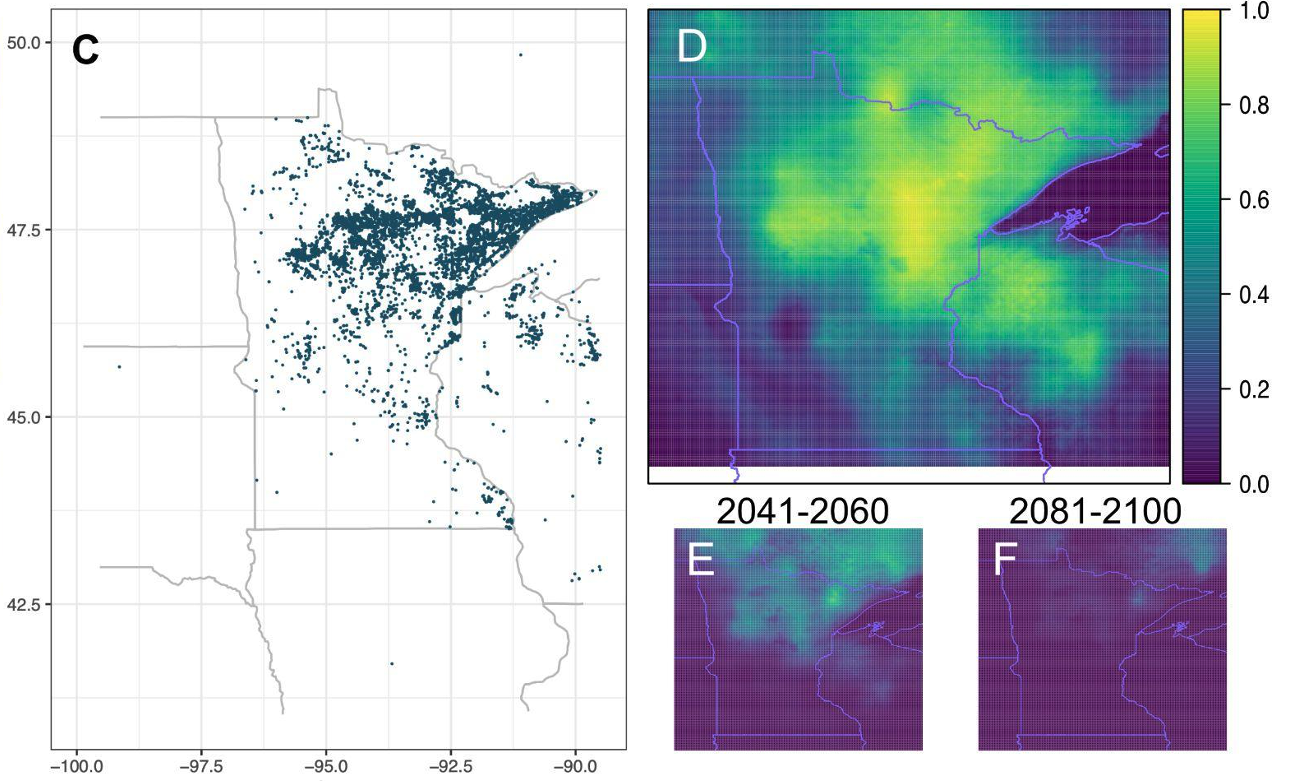 (C) Distribution of common tansy occurrences in Minnesota. (D) Species distribution model based on current environments, (E) projected environment in 2041-2060, and (F) projected environment in 2081-2100
Adaptation differentiation could significantly alter predictions of invasion risk under current and future climates and, if not accounted for, could result in faulty management recommendations. Adaptation has been shown to be important in the process of range expansion in native species, particularly at expanding range margins. In invasive species, it has been suggested and demonstrated that evolutionary changes in the non-native range (compared to the native range) have facilitated invasiveness. However, few studies have explicitly tested for local adaptation and the scale of local adaptation in invasive species across their invaded range. Further, it remains largely unexplored as to how adaptation to current climate variation may influence adaptation to future climates, and the consequences for predictions of range shifts and invasion risk.
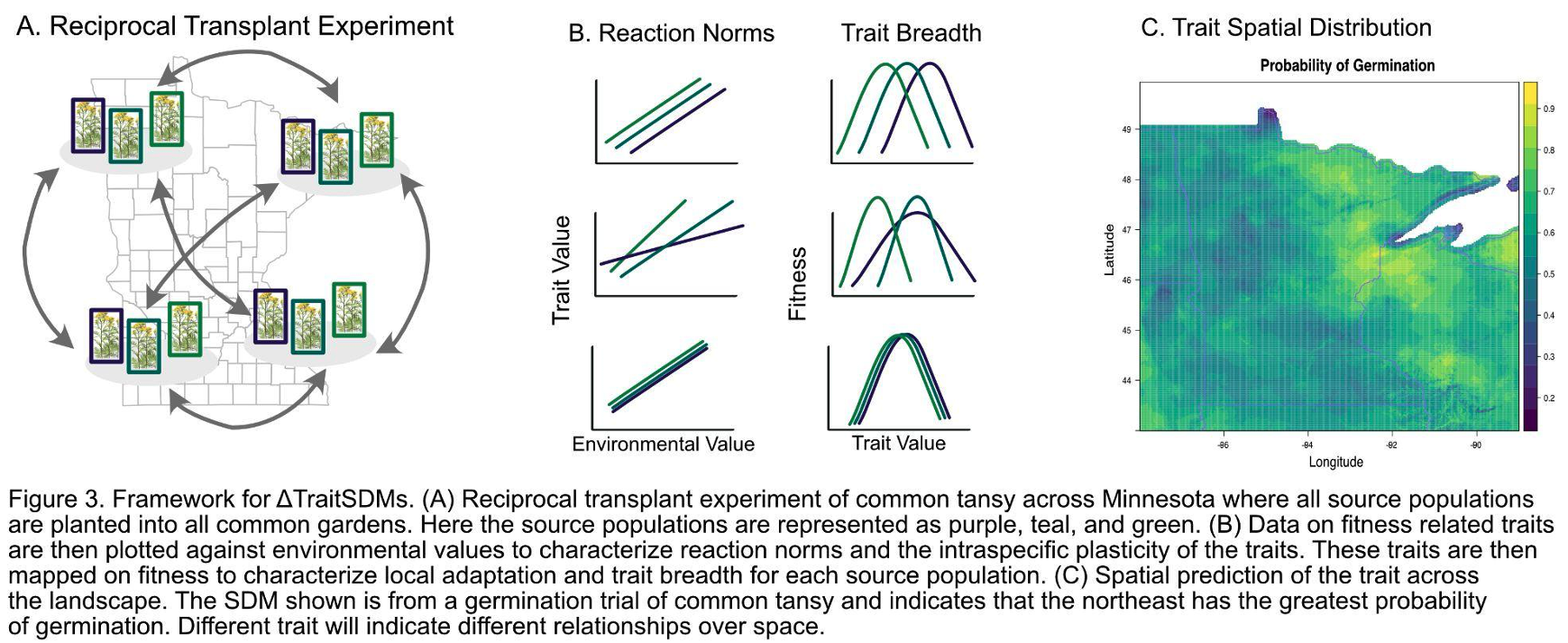
In this project, we are examining the role of local adaptation in the invasion dynamics of common tansy (Tanacetum vulgare; Fig. 1A &1B). Our experiment occurs across four sites in Minnesota. At each site, we have constructed shelters that manipulate precipitation and mesocosms that manipulate temperature. These manipulations occur in the context of a reciprocal transplant design. In addition to planting genotypes of the focal species, common tansy, we have also established native grasses to provide realistic biotic context.
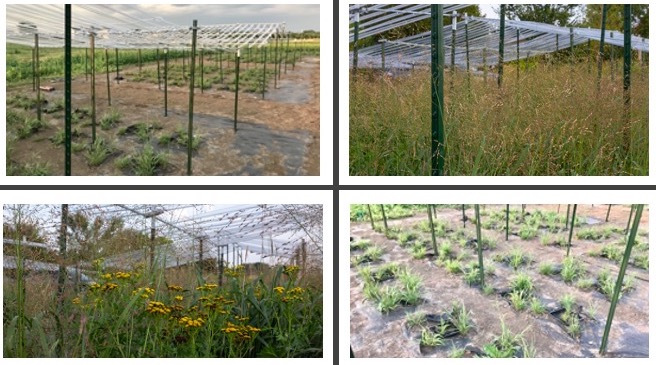 Our transplant studies combined with climate change manipulations will provide substantially refined predictions of range shifts under current and future climate conditions. They will also provide guidance on effective management strategies.



Publications
Briscoe Runquist, R.D. & D.A. Moeller. 2024. Isolation-by-environment and its consequences for range shifts with global change: landscape genomics of the invasive plant common tansy. Molecular Ecology 33:e17462. pdf
Lake, T.A., R.D. Briscoe Runquist, L.E. Flagel, & D.A. Moeller. 2023. Chronosequence of invasion reveals minimal losses of population genomic diversity, niche expansion, and trait divergence in the polyploid, leafy spurge. Evolutionary Applications doi.org/10.1111/eva.13593. pdf
Gorton, A.J., J.W. Benning, P. Tiffin, & D.A. Moeller. 2022. The spatial scale of adaptation in a native annual plant and its implications for responses to climate change. Evolution 76:2916- 2929. pdf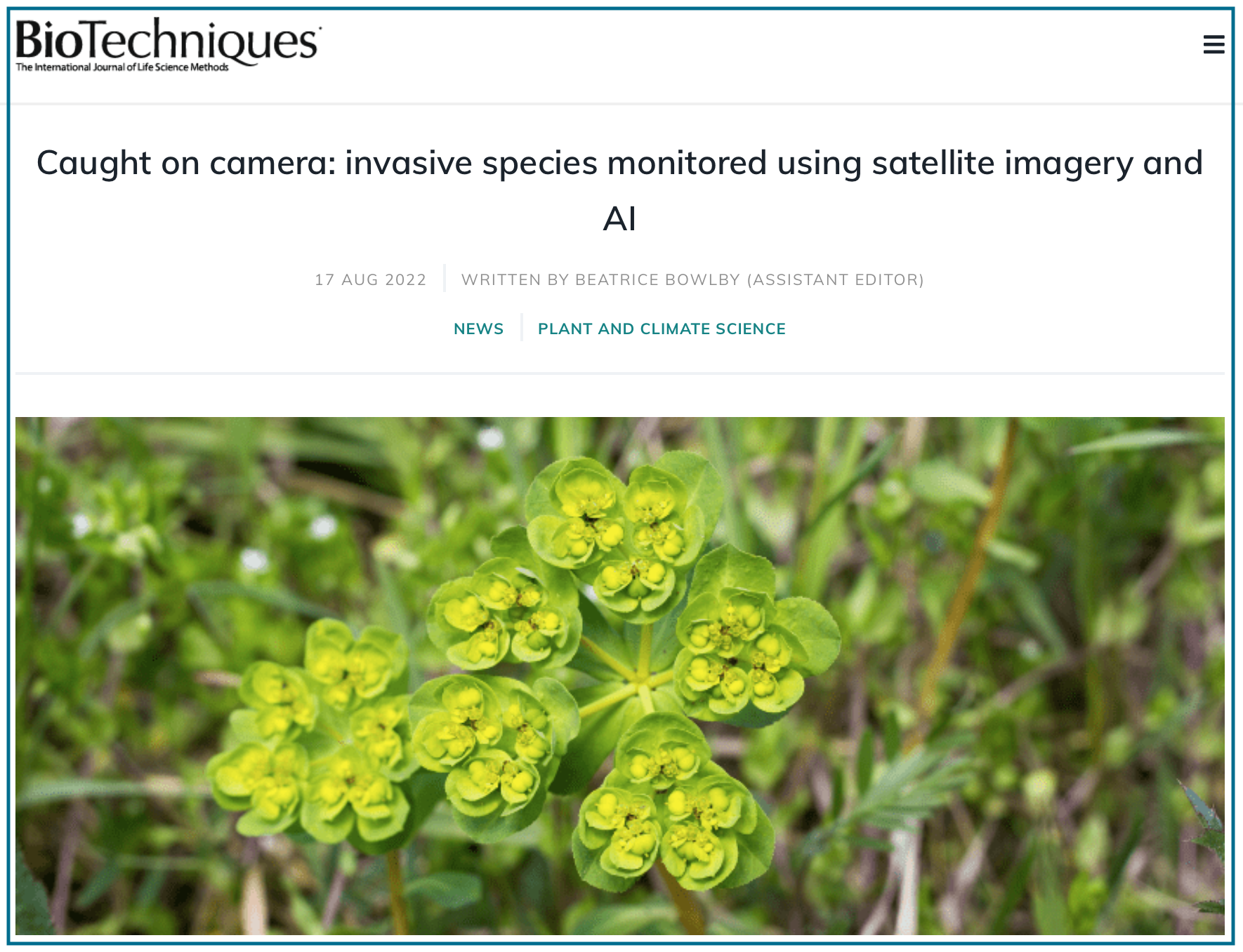
Lake, T.A. Lake, R.D. Briscoe Runquist, & D.A. Moeller. 2022. Deep learning detects invasive plant species across complex landscapes using Worldview-2 and Planetscope satellite imagery. Remote Sensing in Ecology and Conservation 8:875–889. pdf
Briscoe Runquist, R.D., T.A. Lake, & D.A. Moeller. 2021. Improving predictions of range expansion for invasive species using joint species distribution models and surrogate co-occurring species. Journal of Biogeography 48:1693-1705. pdf
Kostanecki, A., A.J. Gorton, & D.A. Moeller. 2021. An urban-rural spotlight: evolution at small spatial scales among urban and rural populations of common ragweed. Journal of Urban Ecology 7:juab004. pdf
Lake, T.A., R.D. Briscoe Runquist, & D.A. Moeller. 2020. Predicting range expansion of invasive species: pitfalls and best practices for obtaining biologically realistic projections. Diversity and Distributions 26:1767–1779. pdf
Gorton, A.J., P. Tiffin, & D.A. Moeller. 2019. Does adaptation to historical climate shape plant responses to future rainfall patterns? A rainfall manipulation experiment with common ragweed. Oecologia 190:941-953. pdf
Briscoe Runquist, R.D., T. Lake, P. Tiffin, and D.A. Moeller. 2019. Species distribution models throughout the invasion history of Palmer amaranth predict regions at risk of future invasion and reveal challenges with modeling rapidly shifting geographic ranges. Scientific Reports 9:2426. pdf
Gorton, A.J., D.A. Moeller, P. Tiffin. 2018. Little plant, big city: a test of adaptation to urban environments in common ragweed (Ambrosia artemisiifolia). Proceedings of the Royal Society of London B. 176:1799-1809. pdf
 Moeller Lab