
Google Scholar
In review
Harrington, A.D. & D.A. Moeller. Hidden in plain sight: Distinguishing a narrow endemic Clarkia from an allopolyploid derivative despite morphological and ecological overlap.
Harrington, A.D. & D.A. Moeller. Polyploidy has predictable effects on niche but not range size.
Comte, L. and 23 authors including D.A. Moeller. At the leading edge: advancing and bridging the science and management of range-shifting species.
Lake, T.A., R.D. Briscoe Runquist, & D.A. Moeller. Two decades of Landsat images reveal spatial and temporal dynamics of invasion and improve species distribution models. preprint
Mueller, T.L. & D.A. Moeller. Endophyte diversity is influenced by host species and environment but community composition is structured by spatial distance. preprint
2026 and in press
Sianta, S.A., B.R. Kern, A. Siri, Y. Brandvain, & D.A. Moeller. 2026. Introgression despite minimal hybridization: mating system modulates phenotypic associations with introgression in Clarkia. New Phytologist, in press.
2025
Kooyers, N.J., J.T. Anderson, A.L. Angert, M.L. Avolio, D.R. Campbell, M. Exposito-Alonso, T.E. Juenger, D.A. Moeller, J.D. Napier, S.N. Sheth. Responses to climate change – insights and limitations from herbaceous plant model systems. New Phytologist. 248:461-493. pdf
Carley, L.N., M.A. Geber, W.F. Morris, V.M. Eckhart, & D.A. Moeller. Long-term population stability predicts the magnitude of local adaptation. Ecology Letters 28:e70071. pdf
2024
Sianta, S., D.A. Moeller, & Y. Brandvain. 2024. The extent of introgression between incipient Clarkia species is determined by temporal environmental variation and mating system. Proceedings of the National Academy of Sciences U.S.A. 121:e2316008121. pdf
Cocciardi, J.M. & 33 other authors including D.A. Moeller. 2024. The value of long-term ecological research for evolutionary insights. Nature Ecology & Evolution 8:1584-1592. link
Briscoe Runquist, R.D. & D.A. Moeller. 2024. Isolation-by-environment and its consequences for range shifts with global change: landscape genomics of the invasive plant common tansy. Molecular Ecology 33:e17462. pdf
Vergara, I.H., M.A. Geber, D.A. Moeller, & V.M. Eckhart. 2024. Population histories of reproductive failure and low winter precipitation correlate with risk-averse seed germination in a Mediterranean-climate winter annual. American Journal of Botany 111:e16412. pdf
2023
Lake, T.A., R.D. Briscoe Runquist, L.E. Flagel, & D.A. Moeller. 2023. Chronosequence of invasion reveals minimal losses of population genomic diversity, niche expansion, and trait divergence in the polyploid, leafy spurge. Evolutionary Applications 16:1680-1696. pdf
Siegmund, G.-F., D.A. Moeller, V.M. Eckhart, & M.A. Geber. 2023. Bet hedging is not sufficient to explain germination patterns of a winter annual plant. American Naturalist 202:767-784. pdf
*Best student paper, American Naturalist 2024
Kern, B.R., L.N. Carley, & D.A. Moeller. 2023. Direct tracking of pollen with quantum dots reveals surprising uniformity in dispersal distance across eleven populations of an annual plant. American Journal of Botany 110:e16201. pdf
*Editor’s choice, Journal Highlights July 2023
Benning, J.W., A. Faulkner, & D.A. Moeller. 2023. Rapid evolution during climate change: demographic and genetic constraints on adaptation to severe drought. Proceedings of the Royal Society B 290:20230336. pdf
Sianta, S.A., S. Peischl, D.A. Moeller, & Y. Brandvain. 2023. The efficacy of selection may increase or decrease with selfing depending upon the recombination environment. Evolution 77:394-408. pdf
2022
Gorton, A.J., J.W. Benning, P. Tiffin, & D.A. Moeller. 2022. The spatial scale of adaptation in a native annual plant and its implications for responses to climate change. Evolution 76:2916- 2929. pdf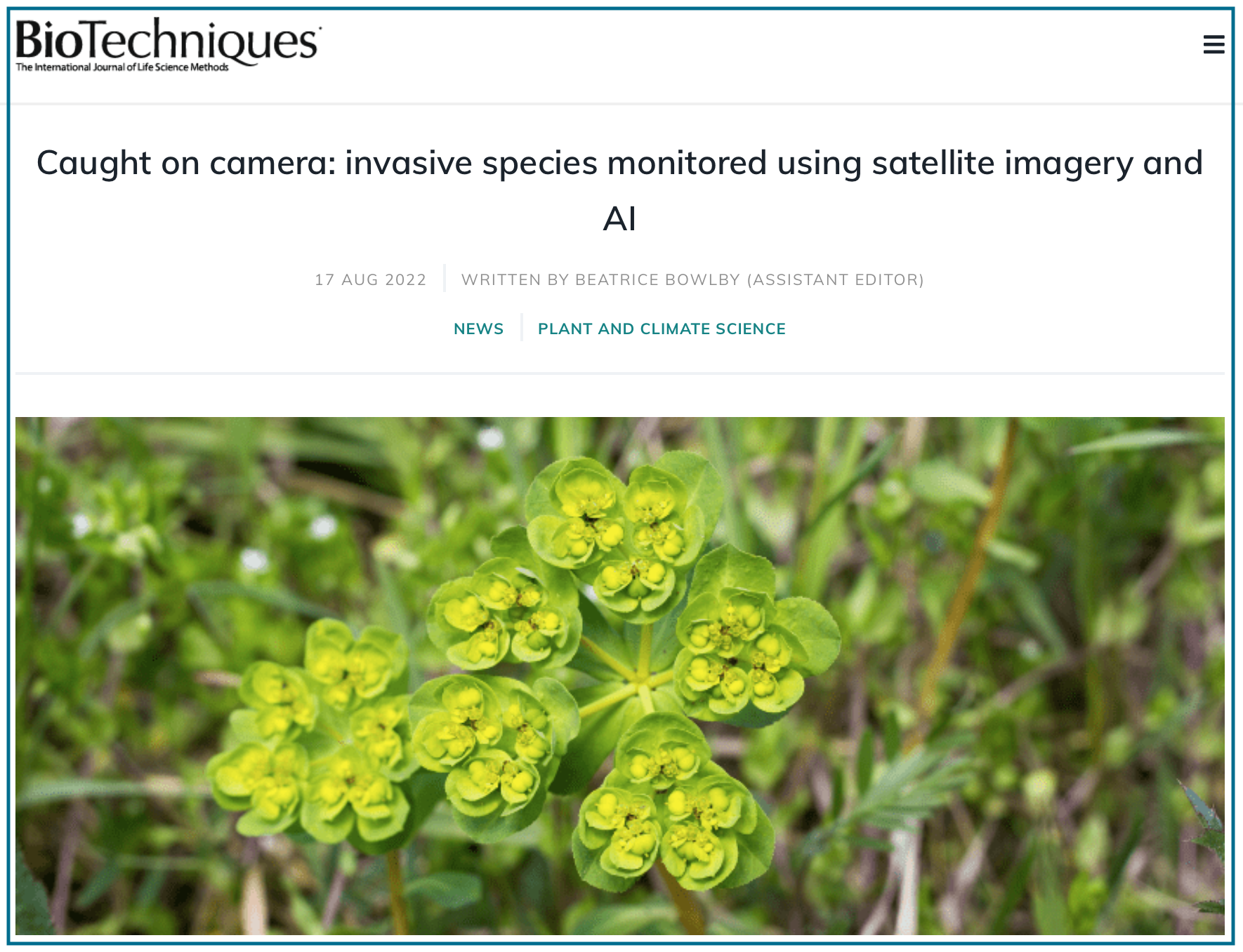
Lake, T.A. Lake, R.D. Briscoe Runquist, & D.A. Moeller. 2022. Deep learning detects invasive plant species across complex landscapes using Worldview-2 and Planetscope satellite imagery. Remote Sensing in Ecology and Conservation 8:875–889. pdf
*AAAS, Biotechniques, Phys.org, & other news outlets
*”Top downloaded article” from the journal
Mueller, T., E. Karlsen-Ayala, D.A. Moeller, & J. Bellemare. 2022. Of mutualism and migration: Will interactions with novel ericoid mycorrhizal communities help or hinder Rhododendron range shifts in response to climate change? Oecologia 198:839-852. pdf
*Journal Cover
2021
Erlandson, S.K., J. Bellemare, & D.A. Moeller. 2021. Limited range-filling among endemic forest herbs of Eastern North America and its implications for conservation with climate change. Frontiers in Ecology and Evolution 9:751728. pdf
Briscoe Runquist, R.D., T.A. Lake, & D.A. Moeller. 2021. Improving predictions of range expansion for invasive species using joint species distribution models and surrogate co-occurring species. Journal of Biogeography 48:1693-1705. pdf
Benning, J.W., & D.A. Moeller. 2021. Microbes, mutualism, and range margins: testing the fitness consequences of soil microbial communities across and beyond a native plant’s range. New Phytologist 229:2886-2900. pdf
Benning, J.W., & D.A. Moeller. 2021. Plant-soil interactions limit lifetime fitness outside a native plant’s geographic range margin. Ecology 102:e03254. pdf
Kostanecki, A., A.J. Gorton, & D.A. Moeller. 2021. An urban-rural spotlight: evolution at small spatial scales among urban and rural populations of common ragweed. Journal of Urban Ecology 7:juab004. pdf
Sullivan L.L., K.P. Sperry, M.J. Michalska-Smith, D.A. Moeller, & A.K. Shaw. 2021. Consequences of ignoring dispersal variation in network models for landscape connectivity. Conservation Biology 35:944-954. pdf
2020
Lake, T.A., R.D. Briscoe Runquist, & D.A. Moeller. 2020. Predicting range expansion of invasive species: pitfalls and best practices for obtaining biologically realistic projections. Diversity and Distributions 26:1767–1779. pdf
Ruane, L.G., S.M. Mangum, K.M. Horner, & D.A. Moeller. 2020. The opportunity for outcrossing varies across the geographic range of the primarily selfing Clarkia xantiana ssp. parviflora. American Journal of Botany 107:1198-1207. pdf
Hämälä, T., A.J. Gorton, D.A. Moeller, & P. Tiffin. 2020. Pleiotropy facilitates local adaptation to distant optima in common ragweed (Ambrosia artemisiifolia). PLoS Genetics 16:e1008707. pdf
 Briscoe Runquist R.D., A.J. Gorton*, J.B. Yoder, N.J. Deacon, J.J. Grossman, S. Kothari, M.P. Lyons, S.N. Sheth, P. Tiffin, & D.A. Moeller. 2020. Context dependence of local adaptation to abiotic and biotic environments: a quantitative and qualitative synthesis. American Naturalist 195:412-431. pdf
*Highlighted in PNAS Front Matter
2019
Benning, J.W.*, & D.A. Moeller. 2019. Maladaptation beyond a geographic range limit driven by antagonistic and mutualistic biotic interactions across an abiotic gradient. Evolution 73: 2044-2059. pdf
Benning, J.W.*, M.A. Geber, V.M. Eckhart, & D.A. Moeller. 2019. Biotic interactions contribute to the geographic range of an annual plant: herbivory and phenology mediate fitness beyond a range margin. American Naturalist 193:786-797. pdf
Gorton, A.J.*, P. Tiffin, & D.A. Moeller. 2019. Does adaptation to historical climate shape plant responses to future rainfall patterns? A rainfall manipulation experiment with common ragweed. Oecologia 190:941-953. pdf
Hargreaves, A.L., E. Suárez, K. Mehltreter, I. Myers-Smith, S.E. Vanderplank, H.L. Slinn, Y.L. Vargas-Rodriguez, S. Haeussler, S. David, J. Muñoz, R.C. Almazán-Núñez, D. Loughnan, J.W. Benning*, D.A. Moeller, J.F. Brodie, H.J.D. Thomas, & P.A. Morales. 2019. Seed predation increases from the Arctic to the Equator and from high to low elevations. Science Advances 5:eaau4403. pdf
Briscoe Runquist, R.D., T. Lake*, P. Tiffin, & D.A. Moeller. 2019. Species distribution models throughout the invasion history of Palmer amaranth predict regions at risk of future invasion and reveal challenges with modeling rapidly shifting geographic ranges. Scientific Reports 9:2426. pdf
2018
Gorton, A.J.*, D.A. Moeller, & P. Tiffin. 2018. Little plant, big city: a test of adaptation to urban environments in common ragweed (Ambrosia artemisiifolia). Proceedings of the Royal Society B. 176:1799-1809. pdf
Pironen, S., J. Villellas, W. Thuiller, V.M. Eckhart, M.A. Geber, D.A. Moeller, & M.B. García. 2018. The “Hutchinsonian niche” as an assemblage of demographic niches: implications for species’ geographic ranges. Ecography. 41:1103-1113. pdf
Bolin, L.G.†, J.W. Benning*, & D.A. Moeller. 2018. Mycorrhizal interactions do not influence plant-herbivore interactions in populations of Clarkia xantiana ssp. xantiana spanning from center to margin of the geographic range. Ecology & Evolution. 8:10743–10753. pdf
2017
Moeller, D.A., R.D. Briscoe Runquist, A.M. Moe, M.A. Geber, C. Goodwillie, P.-O. Cheptou, C.G. Eckert, E. Elle, M.O. Johnston, S. Kalisz, R.H. Ree, R.D. Sargent, M. Vallejo-Marin, & A.A. Winn. 2017. Global biogeography of mating system variation in seed plants. Ecology Letters 20:375-384. pdf
Briscoe Runquist, R.D., M.A. Geber, M. Pickett-Leonard†, & D.A. Moeller. 2017. Mating system evolution under strong pollen limitation: Evidence of disruptive selection through male and female fitness in Clarkia xantiana. American Naturalist 189:549-563. pdf
2014 – 2016
Pettengill, J.B., R.D. Briscoe Runquist, & D.A. Moeller. 2016. Mating system divergence affects the distribution of sequence diversity within and among populations of recently diverged subspecies of Clarkia xantiana (Onagraceae). American Journal of Botany 103:99-109. pdf
*Special Issue on “Evolutionary Insights from Studies of Geographic Variation”
Briscoe Runquist, R.D., E. Chu†, J.L. Iverson†, J.C. Kopp†, & D.A. Moeller. 2014. Rapid evolution of reproductive isolation between incipient outcrossing and selfing Clarkia species. Evolution 68:2885-2900. pdf
Gould, B., D.A. Moeller, V.M. Eckhart, P. Tiffin, & M.A. Geber. 2014. Local adaptation and range boundary formation in response to complex environmental gradients across the geographic range of Clarkia xantiana ssp. xantiana. Journal of Ecology 102:95-107. pdf
Briscoe Runquist, R.D. & D.A. Moeller. 2014. Floral and mating system divergence in  secondary sympatry: testing an alternative hypothesis to reinforcement in Clarkia.
Annals of Botany 100:1916-1921. pdf
*Special Issue on “Pollinator-Driven Speciation”
Bellemare, J. & D.A. Moeller. 2014. Climate change and the herbaceous layer of temperate deciduous forests. in. F.S. Gilliam, ed., The Herbaceous Layer in Forests of Eastern North America (2nd ed.), pp. 460-480. Oxford University Press.
2011 – 2013
Briscoe Runquist, R.D. & D.A. Moeller. 2013. Resource reallocation does not influence estimates of pollen limitation or reproductive assurance in Clarkia xantiana ssp. parviflora (Onagraceae). American Journal of Botany 100:1916-1921. pdf
Pettengill, J.B., & D.A. Moeller. 2012. Phylogeography of speciation: allopatric divergence and secondary contact between outcrossing and selfing Clarkia.
Molecular Ecology 21:4578-4592. pdf
Pettengill, J.B., & D.A. Moeller. 2012. Tempo and mode of mating system evolution between incipient Clarkia species. Evolution 66:1210-1225. pdf
Moeller, D.A., M.A. Geber, V.M. Eckhart, & P. Tiffin. 2012. Reduced pollinator service and elevated pollen limitation at the geographic range limit of an annual plant. Ecology 93:1036-1048. pdf
*Editor’s Choice, Science, June 1, 2012 pdf
Winn, A.A., E. Elle, S. Kalisz, P.-O. Cheptou, C.G. Eckert, C. Goodwillie, M.O. Johnston, D.A. Moeller, R.H. Ree, R.D. Sargent, & M. Vallejo-Marin. 2011. Analysis of inbreeding depression in mixed mating plants provides evidence for selective interference and stable mixed mating. Evolution 65:3339-3359. pdf
Moeller, D.A., M.A. Geber, & P. Tiffin. 2011. Population genetics and the evolution of geographic range limits in an annual plant. American Naturalist 178:S44-S61. pdf
Eckhart, V.M., M.A. Geber, W.F. Morris, E.S. Fabio, P. Tiffin, & D.A. Moeller. 2011. The geography of demography: Long-term demographic studies and species distribution models reveal a species border limited by adaptation. American Naturalist 178:S26-S43. pdf
2008 – 2010
Eckhart, V.M., I. Singh, A.M. Louthan, A.J. Keledjian, A. Chu, D.A. Moeller, & M.A. Geber. 2010. Plant-soil water relations and the species border of Clarkia xantiana ssp. xantiana (Onagraceae). International Journal of Plant Sciences 171: 749-760. pdf
Goodwillie, C., R. Sargent, C.G Eckert, E. Elle, M.A. Geber, M.O. Johnston, S. Kalisz, D.A. Moeller, R.H. Ree, M. Vallejo-Marin, & A. Winn. 2010. Correlated evolution of mating system and floral display traits in flowering plants and its implications for the distribution of mating system variation. New Phytologist 185: 311-321. pdf
Eckert, C.G., S. Kalisz, M.A. Geber , R. Sargent, E. Elle, P.-O. Cheptou, C. Goodwillie, M.O. Johnston, J.K. Kelly, D.A. Moeller, E. Porcher, R.H. Ree, M. Vallejo-Marin, & A. Winn. 2010. Plant mating systems in a changing world. Trends in Ecology & Evolution 25: 35-43. pdf
Johnston, M.O., E. Porcher, P.-O. Cheptou, C.G. Eckert, E. Elle, M.A. Geber, S. Kalisz, J.K. Kelly, D.A. Moeller, M. Vallejo-Marin, & A. Winn. 2009. Correlations among fertility components can maintain mixed mating in plants. American Naturalist 173: 1-11. pdf
Moeller, D.A. & P. Tiffin. 2008. Geographic variation in adaptation at the molecular level: A case study of plant immunity genes. Evolution 62: 3069-3081. pdf
*Faculty of 1000 Biology, Recommended
2005 – 2007
Moeller, D.A., M.I. Tenaillon, & P. Tiffin. 2007. Population structure and its effects on patterns of nucleotide polymorphism in teosinte (Zea mays ssp. parviglumis). Genetics 176: 1799-1809. pdf
Tiffin, P. & D.A. Moeller. 2006. Molecular evolution of plant immune system genes. Trends in Genetics 22: 662-670. pdf
Moeller, D.A. 2006. Geographic structure of pollinator communities, reproductive
assurance, and the evolution of self-pollination. Ecology 87: 1510-1522. pdf
Geber, M.A. & D.A. Moeller. 2006. Pollinator responses to plant communities and implications for reproductive character evolution; in L.D. Harder and S.C.H. Barrett, eds. Ecology and Evolution of Flowers, pp. 102-119. Oxford University Press. pdf
Wheelwright, N.T., E. Dukeshire, J. Fontaine, S. Gutow, D.A. Moeller, J.G. Schuetz, T.M. Smith, S. Rodgers, & A.G. Zink. 2006. Pollinator limitation, autogamy, and minimal inbreeding depression in insect-pollinated plants on a boreal island. American Midland Naturalist 155:19-38. pdf
Moeller, D.A. & P. Tiffin. 2005. Genetic diversity and the evolutionary history of plant immunity genes in two species of Zea. Molecular Biology and Evolution 22: 2480-2490. pdf
Moeller, D.A. & M.A. Geber. 2005. Ecological context of the evolution of self-pollination in Clarkia xantiana: population size, plant communities, and reproductive assurance. Evolution 59: 786-799. pdf
*Journal cover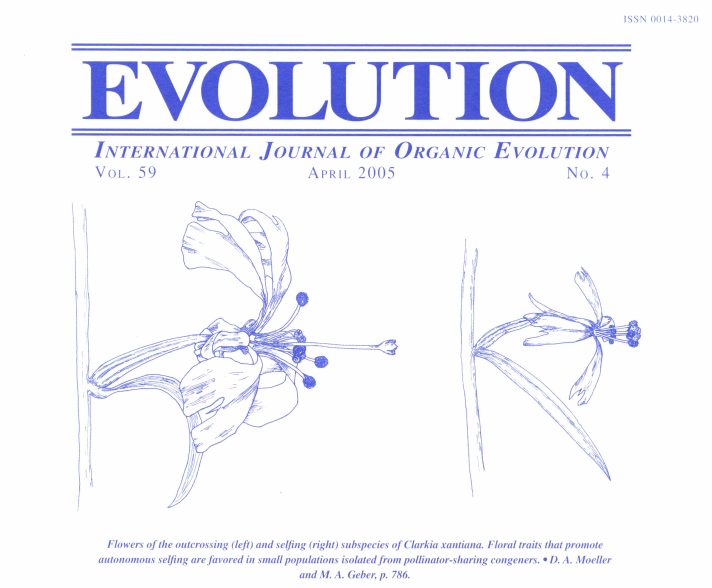
Moeller, D.A. 2005. Pollinator community structure and sources of spatial variation in plant-pollinator interactions in Clarkia xantiana ssp. xantiana. Oecologia 142: 28-37. pdf
2004 and prior
Moeller, D.A. 2004. Facilitative interactions among plants via shared pollinators. Ecology 85: 3289-3301. pdf
Moeller, D.A. & B.A. Schaal. 1999. Genetic relationships among Native American maize accessions of the Great Plains assessed by RAPDs. Theoretical and Applied Genetics 99: 1061-1067. pdf
Schaal, B.A., L.J.C.B. Carvalho, T. Prinzie, K. Olsen, M. Hernandez, G. Cabral, & D.A. Moeller. 1997. Phylogenetic relationships and genetic diversity in Manihot species. African Journal of Root and Tuber Crops 2: 147-149.
* Graduate Student Author † Undergraduate Author
 Moeller Lab