In review
Briscoe Runquist, R.D., J.W. Benning, & D.A. Moeller. Expansion load reduces fitness at the range margin of an invasive plant. preprint
Kern, B.R., S.A. Sianta, Y. Brandvain, and D.A. Moeller. Genetic architecture of pollinator responses to recent population divergence in floral traits and mating system.
Mueller, T.L. & D.A. Moeller. Endophyte diversity is influenced by host species and environment but community composition is structured by spatial distance. preprint
2026 and in press
Lake, T.A., R.D. Briscoe Runquist, & D.A. Moeller. Two decades of Landsat images reveal spatial and temporal dynamics of invasion and improve species distribution models. Ecological Applications, in press. preprint
Sianta, S.A., B.R. Kern, A. Siri, Y. Brandvain, & D.A. Moeller. 2026. Introgression despite minimal hybridization: mating system modulates phenotypic associations with introgression in Clarkia. New Phytologist 250: 2619-2633. pdf
Harrington, A.D. & D.A. Moeller. 2026. Hidden in plain sight: Distinguishing a narrow endemic Clarkia from an allopolyploid derivative despite morphological and ecological overlap. Plant Systematics and Evolution 312, 36. pdf
Harrington, A.D. & D.A. Moeller. 2026. Niche position mediates the effect of polyploidy on geographic range size in Clarkia. Journal of Biogeography 53, e70291. pdf
Comte, L. et al. (24 authors). 2026. At the leading edge: advancing and bridging the science and management of range-shifting species. Bioscience. biag088. pdf
2025
Kooyers, N.J., J.T. Anderson, A.L. Angert, M.L. Avolio, D.R. Campbell, M. Exposito-Alonso, T.E. Juenger, D.A. Moeller, J.D. Napier, S.N. Sheth. Responses to climate change – insights and limitations from herbaceous plant model systems. New Phytologist. 248:461-493. pdf
Carley, L.N., M.A. Geber, W.F. Morris, V.M. Eckhart, & D.A. Moeller. Long-term population stability predicts the magnitude of local adaptation. Ecology Letters 28:e70071. pdf
2024
Sianta, S., D.A. Moeller, & Y. Brandvain. 2024. The extent of introgression between incipient Clarkia species is determined by temporal environmental variation and mating system. Proceedings of the National Academy of Sciences U.S.A. 121:e2316008121. pdf
Cocciardi, J.M. & 33 other authors including D.A. Moeller. 2024. The value of long-term ecological research for evolutionary insights. Nature Ecology & Evolution 8:1584-1592. link
Briscoe Runquist, R.D. & D.A. Moeller. 2024. Isolation-by-environment and its consequences for range shifts with global change: landscape genomics of the invasive plant common tansy. Molecular Ecology 33:e17462. pdf
Vergara, I.H., M.A. Geber, D.A. Moeller, & V.M. Eckhart. 2024. Population histories of reproductive failure and low winter precipitation correlate with risk-averse seed germination in a Mediterranean-climate winter annual. American Journal of Botany 111:e16412. pdf
2023
Lake, T.A., R.D. Briscoe Runquist, L.E. Flagel, & D.A. Moeller. 2023. Chronosequence of invasion reveals minimal losses of population genomic diversity, niche expansion, and trait divergence in the polyploid, leafy spurge. Evolutionary Applications 16:1680-1696. pdf
Siegmund, G.-F., D.A. Moeller, V.M. Eckhart, & M.A. Geber. 2023. Bet hedging is not sufficient to explain germination patterns of a winter annual plant. American Naturalist 202:767-784. pdf
*Best student paper, American Naturalist 2024
Kern, B.R., L.N. Carley, & D.A. Moeller. 2023. Direct tracking of pollen with quantum dots reveals surprising uniformity in dispersal distance across eleven populations of an annual plant. American Journal of Botany 110:e16201. pdf
*Editor’s choice, Journal Highlights July 2023
Benning, J.W., A. Faulkner, & D.A. Moeller. 2023. Rapid evolution during climate change: demographic and genetic constraints on adaptation to severe drought. Proceedings of the Royal Society B 290:20230336. pdf
Sianta, S.A., S. Peischl, D.A. Moeller, & Y. Brandvain. 2023. The efficacy of selection may increase or decrease with selfing depending upon the recombination environment. Evolution 77:394-408. pdf
2022
Gorton, A.J., J.W. Benning, P. Tiffin, & D.A. Moeller. 2022. The spatial scale of adaptation in a native annual plant and its implications for responses to climate change. Evolution 76:2916- 2929. pdf
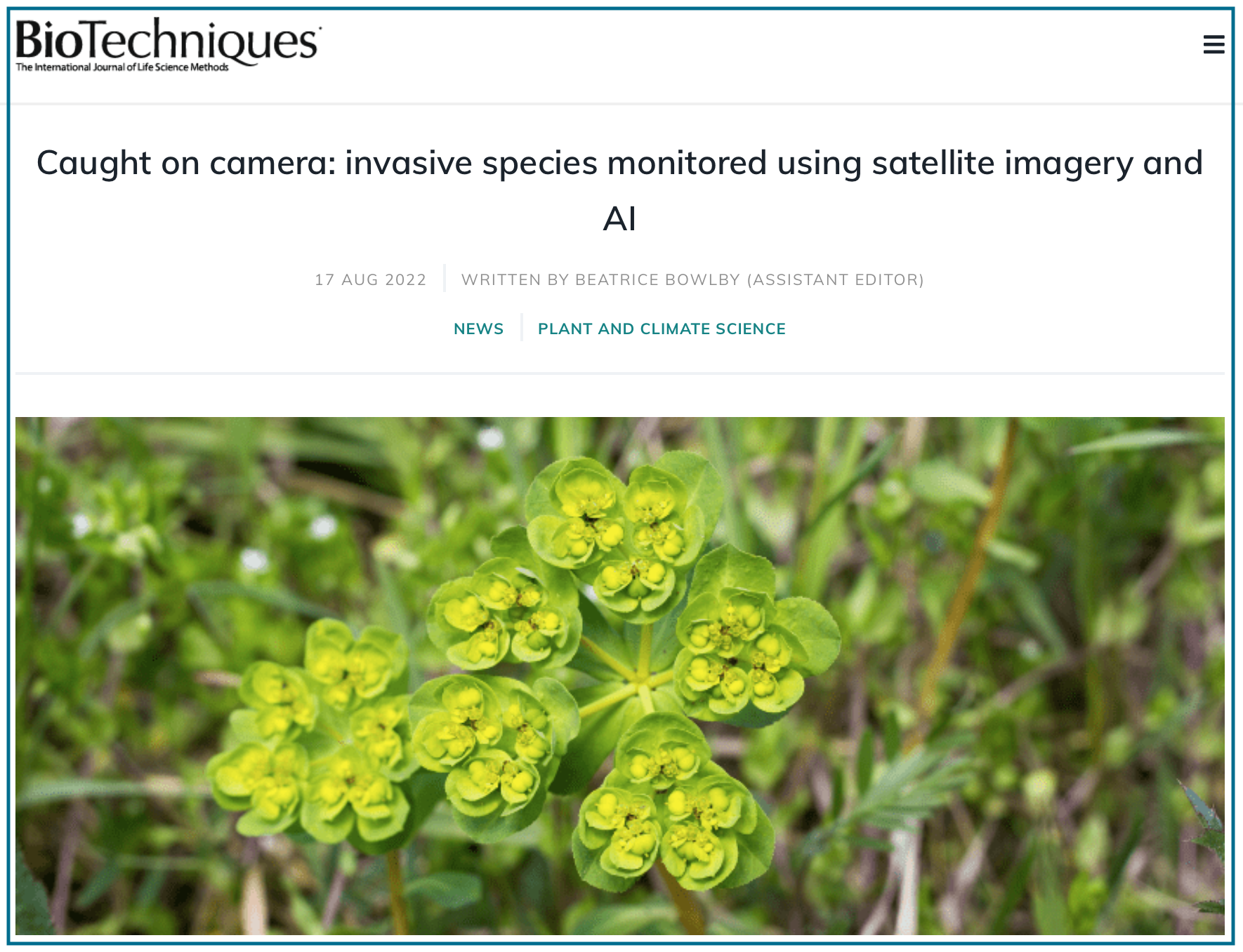
Lake, T.A. Lake, R.D. Briscoe Runquist, & D.A. Moeller. 2022. Deep learning detects invasive plant species across complex landscapes using Worldview-2 and Planetscope satellite imagery. Remote Sensing in Ecology and Conservation 8:875–889. pdf
*AAAS, Biotechniques, Phys.org, & other news outlets
*”Top downloaded article” from the journal

Mueller, T., E. Karlsen-Ayala, D.A. Moeller, & J. Bellemare. 2022. Of mutualism and migration: Will interactions with novel ericoid mycorrhizal communities help or hinder Rhododendron range shifts in response to climate change? Oecologia 198:839-852. pdf
*Journal Cover
2021
Erlandson, S.K., J. Bellemare, & D.A. Moeller. 2021. Limited range-filling among endemic forest herbs of Eastern North America and its implications for conservation with climate change. Frontiers in Ecology and Evolution 9:751728. pdf
Briscoe Runquist, R.D., T.A. Lake, & D.A. Moeller. 2021. Improving predictions of range expansion for invasive species using joint species distribution models and surrogate co-occurring species. Journal of Biogeography 48:1693-1705. pdf
Benning, J.W., & D.A. Moeller. 2021. Microbes, mutualism, and range margins: testing the fitness consequences of soil microbial communities across and beyond a native plant’s range. New Phytologist 229:2886-2900. pdf
Benning, J.W., & D.A. Moeller. 2021. Plant-soil interactions limit lifetime fitness outside a native plant’s geographic range margin. Ecology 102:e03254. pdf
Kostanecki, A., A.J. Gorton, & D.A. Moeller. 2021. An urban-rural spotlight: evolution at small spatial scales among urban and rural populations of common ragweed. Journal of Urban Ecology 7:juab004. pdf
Sullivan L.L., K.P. Sperry, M.J. Michalska-Smith, D.A. Moeller, & A.K. Shaw. 2021. Consequences of ignoring dispersal variation in network models for landscape connectivity. Conservation Biology 35:944-954. pdf
2020
Lake, T.A., R.D. Briscoe Runquist, & D.A. Moeller. 2020. Predicting range expansion of invasive species: pitfalls and best practices for obtaining biologically realistic projections. Diversity and Distributions 26:1767–1779. pdf
Ruane, L.G., S.M. Mangum, K.M. Horner, & D.A. Moeller. 2020. The opportunity for outcrossing varies across the geographic range of the primarily selfing Clarkia xantiana ssp. parviflora. American Journal of Botany 107:1198-1207. pdf
Hämälä, T., A.J. Gorton, D.A. Moeller, & P. Tiffin. 2020. Pleiotropy facilitates local adaptation to distant optima in common ragweed (Ambrosia artemisiifolia). PLoS Genetics 16:e1008707. pdf

Briscoe Runquist R.D., A.J. Gorton*, J.B. Yoder, N.J. Deacon, J.J. Grossman, S. Kothari, M.P. Lyons, S.N. Sheth, P. Tiffin, & D.A. Moeller. 2020. Context dependence of local adaptation to abiotic and biotic environments: a quantitative and qualitative synthesis. American Naturalist 195:412-431. pdf
*Highlighted in PNAS Front Matter
2019
Benning, J.W.*, & D.A. Moeller. 2019. Maladaptation beyond a geographic range limit driven by antagonistic and mutualistic biotic interactions across an abiotic gradient. Evolution 73: 2044-2059. pdf
Benning, J.W.*, M.A. Geber, V.M. Eckhart, & D.A. Moeller. 2019. Biotic interactions contribute to the geographic range of an annual plant: herbivory and phenology mediate fitness beyond a range margin. American Naturalist 193:786-797. pdf
Gorton, A.J.*, P. Tiffin, & D.A. Moeller. 2019. Does adaptation to historical climate shape plant responses to future rainfall patterns? A rainfall manipulation experiment with common ragweed. Oecologia 190:941-953. pdf
Hargreaves, A.L., E. Suárez, K. Mehltreter, I. Myers-Smith, S.E. Vanderplank, H.L. Slinn, Y.L. Vargas-Rodriguez, S. Haeussler, S. David, J. Muñoz, R.C. Almazán-Núñez, D. Loughnan, J.W. Benning*, D.A. Moeller, J.F. Brodie, H.J.D. Thomas, & P.A. Morales. 2019. Seed predation increases from the Arctic to the Equator and from high to low elevations. Science Advances 5:eaau4403. pdf
Briscoe Runquist, R.D., T. Lake*, P. Tiffin, & D.A. Moeller. 2019. Species distribution models throughout the invasion history of Palmer amaranth predict regions at risk of future invasion and reveal challenges with modeling rapidly shifting geographic ranges. Scientific Reports 9:2426. pdf
2018
Gorton, A.J.*, D.A. Moeller, & P. Tiffin. 2018. Little plant, big city: a test of adaptation to urban environments in common ragweed (Ambrosia artemisiifolia). Proceedings of the Royal Society B. 176:1799-1809. pdf
Pironen, S., J. Villellas, W. Thuiller, V.M. Eckhart, M.A. Geber, D.A. Moeller, & M.B. García. 2018. The “Hutchinsonian niche” as an assemblage of demographic niches: implications for species’ geographic ranges. Ecography. 41:1103-1113. pdf
Bolin, L.G.†, J.W. Benning*, & D.A. Moeller. 2018. Mycorrhizal interactions do not influence plant-herbivore interactions in populations of Clarkia xantiana ssp. xantiana spanning from center to margin of the geographic range. Ecology & Evolution. 8:10743–10753. pdf
2017
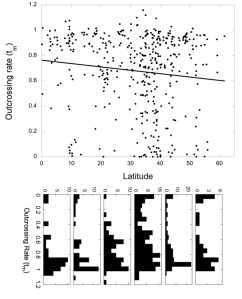
Moeller, D.A., R.D. Briscoe Runquist, A.M. Moe, M.A. Geber, C. Goodwillie, P.-O. Cheptou, C.G. Eckert, E. Elle, M.O. Johnston, S. Kalisz, R.H. Ree, R.D. Sargent, M. Vallejo-Marin, & A.A. Winn. 2017. Global biogeography of mating system variation in seed plants. Ecology Letters 20:375-384. pdf
Briscoe Runquist, R.D., M.A. Geber, M. Pickett-Leonard†, & D.A. Moeller. 2017. Mating system evolution under strong pollen limitation: Evidence of disruptive selection through male and female fitness in Clarkia xantiana. American Naturalist 189:549-563. pdf
 Moeller Lab